Chasing Pirate Ships Through Three Centuries of Paper

Every scene in Crimson Cross: Azure Waves starts long before a word goes on the page, with a stack of dry, dusty records that most people would never think to open. Admiralty court transcripts. Ship's manifests. Harbor logs from Nassau and Port Royal, written in cramped hands by clerks who never imagined anyone would care three hundred years later. That's where Samuel Drayton's world actually lives.
Where the Trail Started
I didn't set out to become someone who can tell a sloop's rigging from a brigantine's at a glance, but that's where the research took me. Early on, I wrote a scene where Samuel's crew came about into the wind with the wrong sail configuration entirely, a mistake that would have made any sailor from 1699 wince. Fixing it meant learning to read old rigging diagrams, cross-referencing them against surviving ship's plans, and working out how a small, fast vessel built for speed and shallow water actually handled compared to the lumbering merchantmen it preyed on. The words "weather gauge" and "close-hauled" now live rent-free in my head.
Nassau in the late 1690s wasn't the postcard image people carry around today. It was a half-abandoned English settlement with no real government, which is exactly why pirates flocked there: no customs house, no navy patrol worth worrying about, just a deep harbor and a population willing to trade with anyone who paid. Rebuilding that town on the page meant working from old harbor surveys and settler accounts, matched against what little remains of the physical geography today.
The Democracy Nobody Expects
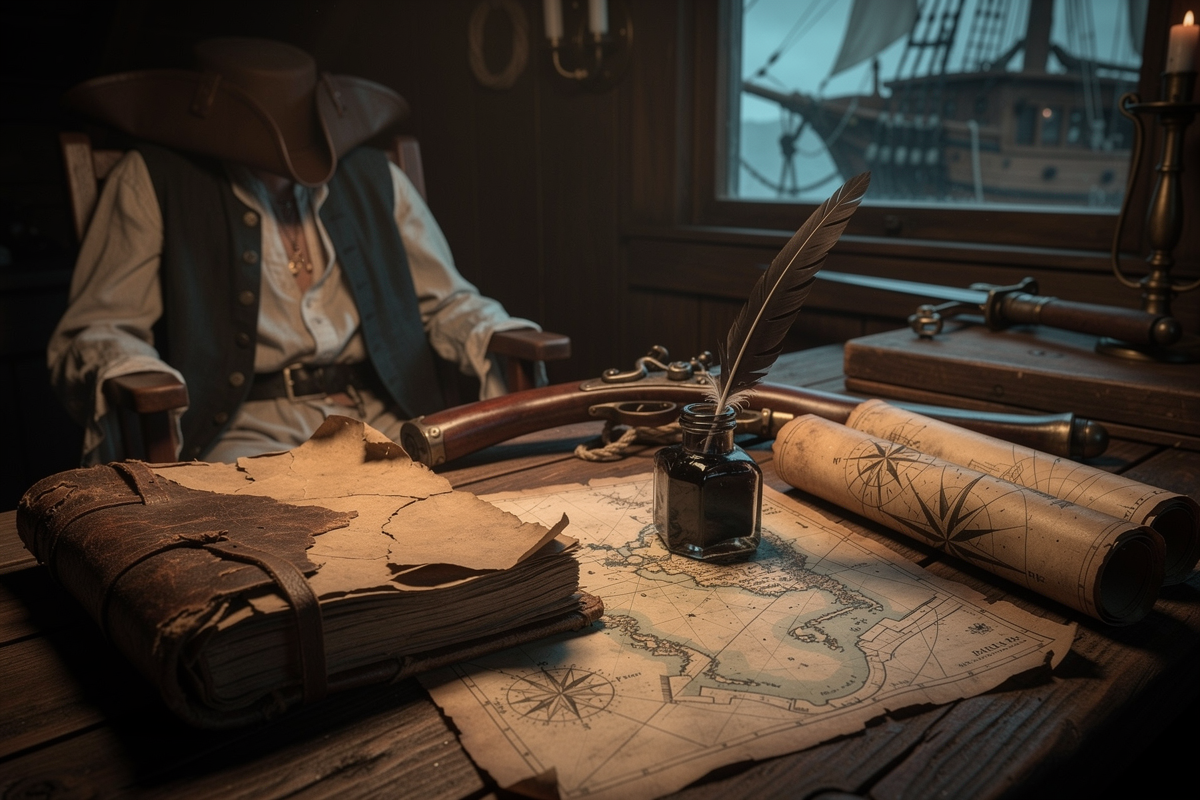
The detail that surprised me most wasn't about ships or harbors. It was about government. Pirate crews ran on written articles that every man signed before a voyage began: how profits were split, what compensation a man received for losing an eye or a limb in a fight, and, this is the part readers find hardest to believe, the crew voted their captain into the role and could vote him back out. A captain who couldn't win a fight or divide plunder fairly didn't stay captain long. It's a long way from the swashbuckling loner built out of old movies, and it's a much better story besides. Samuel doesn't inherit authority in these pages. He has to earn it, meeting by meeting, vote by vote, the same way any real pirate captain did.
That single fact reshaped how I wrote Sable's introduction and Samuel's early chapters aboard ship. He arrives expecting hierarchy and instead finds a floating republic with its own rough justice, a system with real teeth, since a broken article could mean marooning or worse. Once I understood that, half a dozen scenes in Act Two got rewritten to make his adjustment feel earned instead of convenient.
Small Details, Big Stakes
None of this research shows up as a lecture on the page. Nobody wants a history footnote in the middle of a boarding action. But it sits underneath every scene the way ballast sits under a ship's deck: invisible, and the reason nothing tips over. With Azure Waves heading toward its mid-2026 release, that groundwork is the part I'm proudest of. Readers who know this era will, I hope, feel at home. Readers who don't will come away knowing a little more about how the Golden Age of Piracy actually worked, articles and all.
Crimson Cross: Azure Waves is available for preorder now, hardcover for $49.99 and paperback for $19.99, expected mid-2026. If you want a taste first, Chapter One is free on the site. Come find the ships, the harbors, and the articles that shaped this world on YouTube @Chris.Stirling, TikTok @chris_stirling, and Instagram @chrisstirling.writer.
Keep reading the saga
Get the first chapter of Crimson Cross: Azure Waves free, or preorder the book.
Send me Chapter One