Nassau Before the Legend: The Harbor My Pirates Actually Sailed Into
A Town Renamed for a King
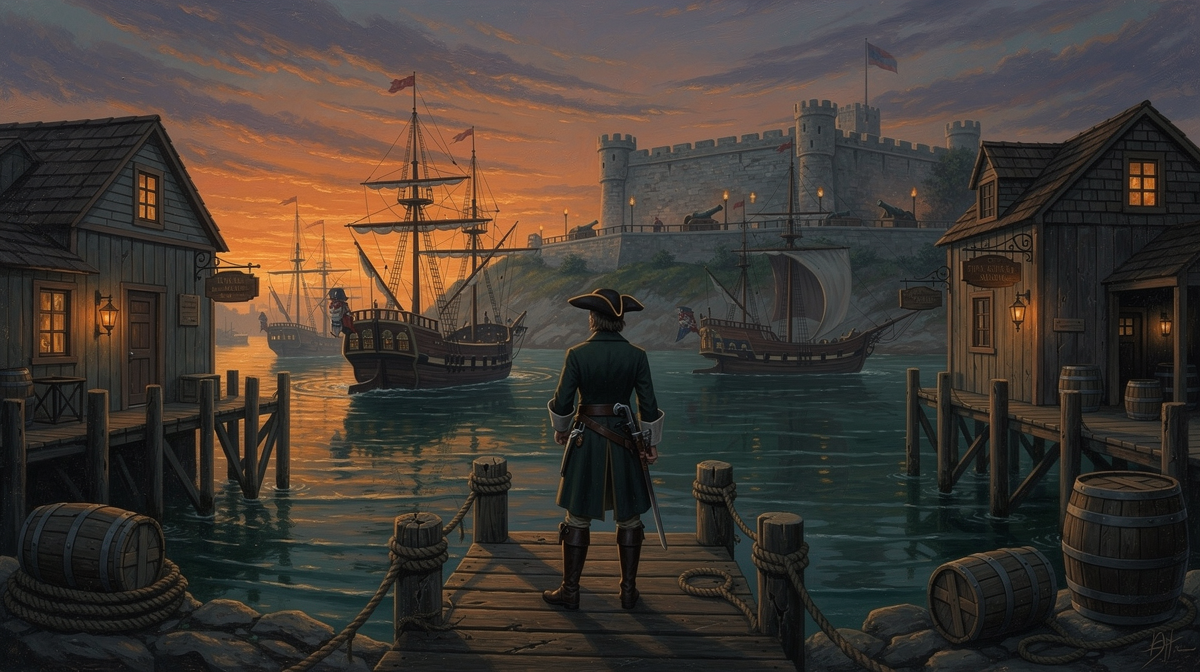
When I started drafting Azure Waves, I almost defaulted to the Nassau everyone already knows: the lawless pirate republic of Woodes Rogers and Blackbeard, flags snapping over a harbor packed with brigantines. That Nassau is real, and it is a gift to any writer of piracy fiction. It is also almost twenty years too late for Samuel Drayton.
In 1699, when Samuel first sets foot on New Providence, the town is not even old under its current name. It had been Charles Town, burned to cinders by a Spanish raiding party in 1684, then rebuilt and rechristened Nassau in 1695 by governor Nicholas Trott, who named it for the royal house of William III. Trott lasted two more years in the post, and not because he ran an honest harbor. In 1696 the pirate Henry Avery sailed the Fancy into that same anchorage and reportedly bought Trott's cooperation with a share of his plunder, no questions asked about where a ship that size and that rich had come from. Trott was removed from office not long after, though the bribery was never proven outright. That is the town Samuel inherits: a harbor where a governor's corruption is still fresh in living memory, held since by men named Webb and then Elding, each occupying a proprietary post that London seemed to police only when convenient.
The proprietors who nominally ran the Bahamas were the same Lords Proprietors of Carolina who governed Charleston, Samuel's home. That detail did more work in my outline than I expected once I found it. The corruption chasing Samuel out of Charleston and the corruption waiting for him in Nassau share an address in London. Neither colony could count on its own governor to protect it, and neither, in 1699, had much reason to trust the men sent to run it.
I wanted that instability in the book because it is the truer version of how piracy actually worked in the Caribbean at the turn of the century. It was not a black flag and a code of honor operating outside the law. It was colonial administrators looking the other way, sometimes for a fee, inside a system too thin and too far from home to stop them.
The Frontier Harbor, Not the Republic
Strip away the legend and New Providence in 1699 is a working harbor first. Good anchorage, fresh water, timber for careening ships, and enough distance from any real naval patrol to make it useful to smugglers, privateers gone idle after a peace treaty, and honest traders who were not asking too many questions either. The town itself was small, a scatter of houses, a fort in poor repair, a population that swelled and emptied with the ships riding at anchor. Under the Lords Proprietors of Carolina, the same authority that technically governed Charleston, the Bahamas sat at the far edge of an administration that had its hands full closer to home.
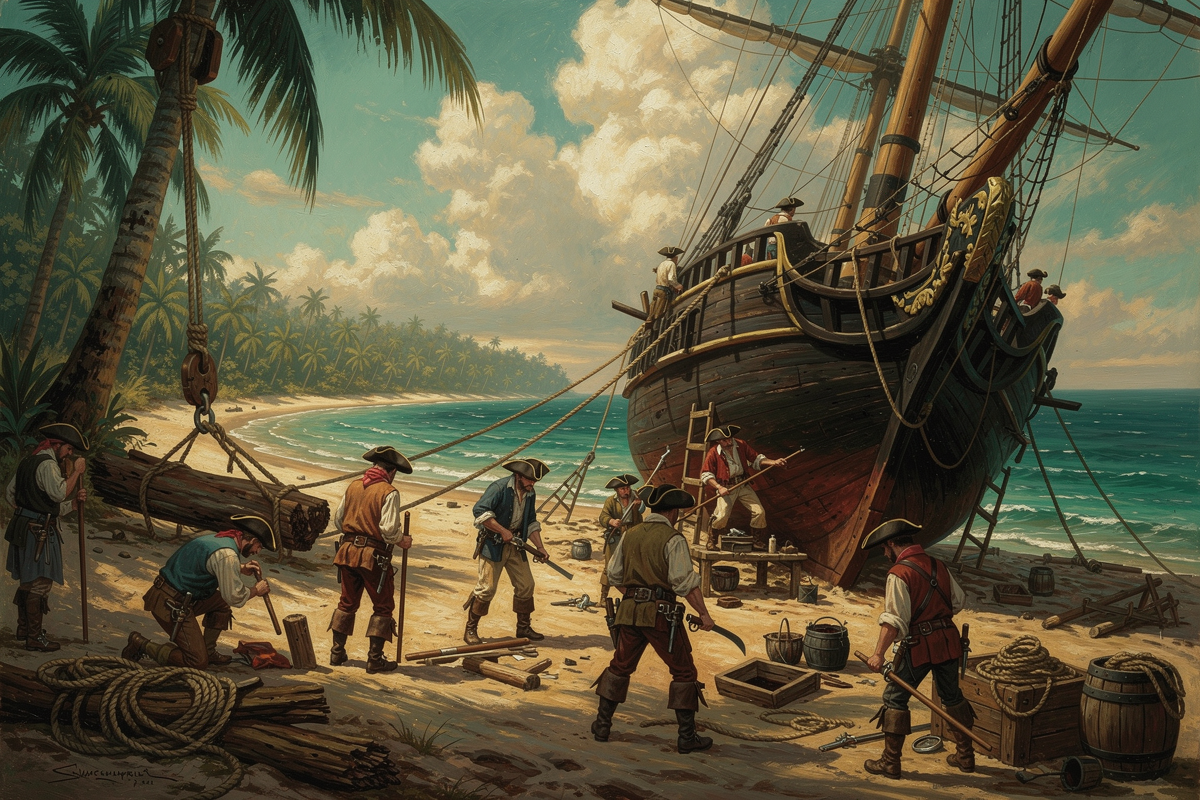
Careening a ship at New Providence was not a quiet business. Crews ran a vessel up onto a sloping beach at high tide, stripped her of guns and stores, then hauled her onto her side with block and tackle rigged to trees onshore, exposing a hull fouled with barnacles and riddled by shipworm. Men scraped the timbers raw, patched what the worms had eaten through, and payed the seams with hot pitch that filled the air with a smell no one who has stood near it forgets. It was slow, filthy, essential work, and it is exactly the kind of labor the legend skips past in favor of flags and treasure.
It is also, and this matters to me as a writer trying to get the history right, a genuinely mixed community. The crews moving through that harbor were not the homogenous bands popular film likes to paint. Free Black sailors, men who had escaped or won their freedom and were building lives at sea that the mainland colonies denied them, worked alongside English, Dutch, and Spanish speaking hands on the same ships, sometimes voting on the same articles that governed a voyage's discipline and its shared spoils. That is not artistic license on my part. It is documented fact about how these crews actually organized themselves, and it is one of the reasons the pirate ships in Azure Waves look the way they do.
What Samuel and Sable Find There
Samuel arrives at New Providence still carrying Charleston on him, in the cut of his coat and the careful way he counts a room before he speaks. Nassau does not care. It is the first place in the book where his name and his father's name buy him nothing, and where the woman who becomes his hardest teacher has no patience for a young man who still thinks manners are armor. Sable has run this coastline long enough to read a harbor the way Samuel used to read a ledger, and the gap between those two skills is most of what his education in Act Two is built on.
What she teaches him first has nothing to do with a blade. It is how to read a harbor full of strangers and know, within a glance, which ships are worth avoiding, which captains keep their word, and which men are one bad night from turning on their own crew. Charleston never once asked that of him.
I keep returning to Nassau in this era because it lets me write pirates as they actually were, rather than as they have been flattened into over three centuries of retelling. Opportunists and outcasts and skilled sailors building a rough kind of order in the gaps a colonial system left open, a full generation before anyone thought to call that harbor a republic.
If Nassau's early years already have you wanting more, Chapter One of Azure Waves is free to read on the site. Crimson Cross: Azure Waves is available for preorder now in hardcover ($49.99) and paperback ($19.99), expected mid-2026. Come along on YouTube at @Chris.Stirling, on TikTok at @chris_stirling, and on Instagram at @chrisstirling.writer.
Keep reading the saga
Get the first chapter of Crimson Cross: Azure Waves free, or preorder the book.
Send me Chapter One