No Prey, No Pay: The Pirate Code Samuel Drayton Learned to Live By
A Contract Before a Single Sail Was Raised
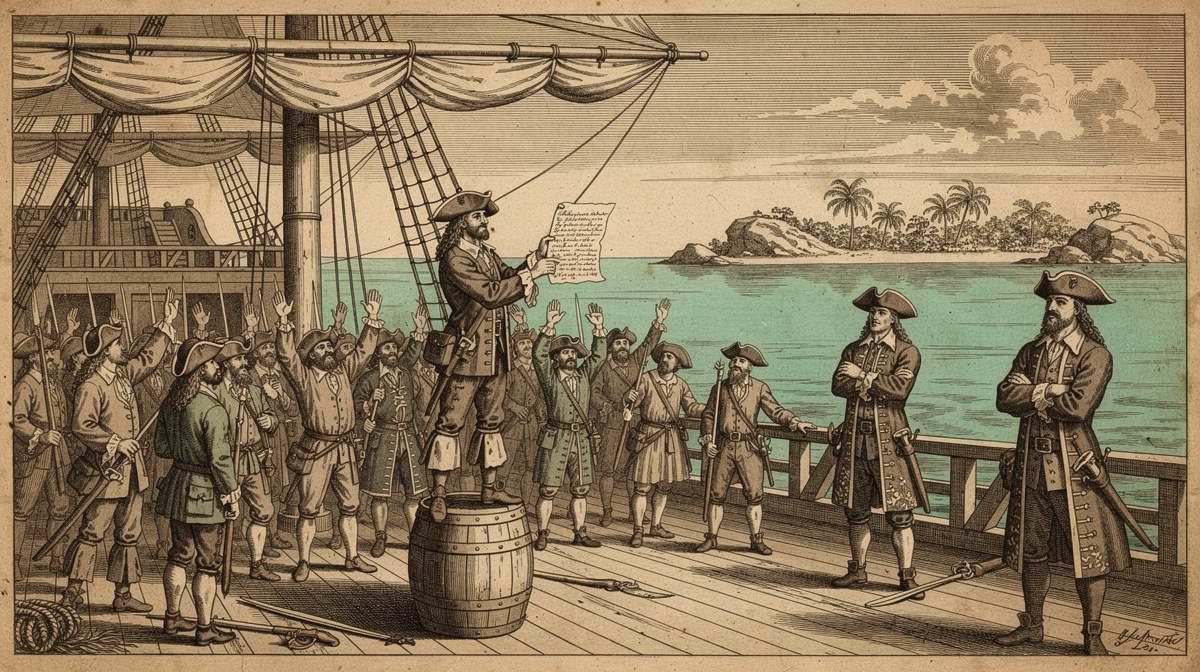
Ask most people what ruled a pirate ship, and they picture a tyrant with a cutlass and a foul temper, every man on board cowering under his word. The truth on most vessels during the Golden Age of Piracy ran the opposite direction. Before a crew ever cleared harbor, they gathered on deck and hammered out a set of written articles, a contract every man signed or marked with an X, swearing to abide by rules he'd had a hand in writing.
The custom traces back further than most readers expect. Buccaneers raiding the Spanish Main in the 1660s and 1670s under men like Henry Morgan operated under an arrangement sailors called "no prey, no pay." A French surgeon named Alexandre Exquemelin sailed with Morgan's band and later published an eyewitness account of how those crews organized themselves, an early record of a system built on shared risk and shared reward. By the final years of the seventeenth century, when a Charleston gentleman might find himself dragged into that world with no warning at all, the articles were not some new invention. They were old custom, tested by two generations of men who had learned the hard way what happens when a crew hands one man unchecked power at sea.
A ship's carpenter or a gunner might sail under three or four different captains across a career, and every single time, before the anchor came up, the crew stood on deck to hash the articles out fresh. Nothing carried over automatically. Every voyage started with the same question: what do we owe each other, and what happens if one of us breaks the promise?
What the Articles Actually Said
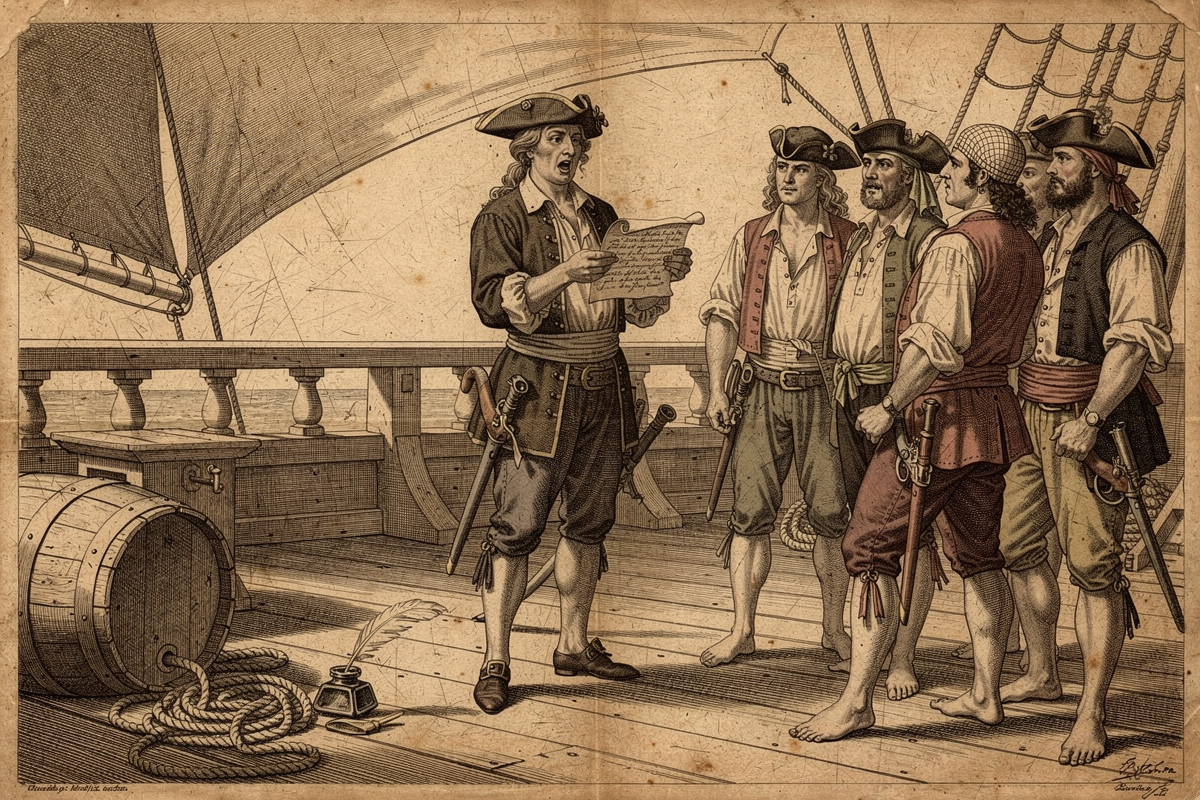
Every crew's document differed in its particulars, but certain clauses turn up again and again in the surviving records. Every man got a vote in matters that touched the whole crew: where to sail, whether to fight, whom to elect captain. That last part surprises people most. A pirate captain held near-absolute authority only in battle. The rest of the time, a quartermaster, elected separately, handled the ship's stores, settled disputes among the crew, and doled out punishment, a built-in check against any captain who got ideas above his station.
Plunder followed a formula, not a whim. A captain typically drew a share and a half, sometimes two. The quartermaster, gunner, boatswain, and carpenter took a share and a quarter apiece for the specialized work that kept the ship afloat and armed. Everyone else split a single share. Compare that to a Royal Navy vessel of the same decade, where officers drew fortunes and an ordinary seaman could die of scurvy for a wage that arrived months late, if it arrived at all, and the appeal of piracy stops looking so mysterious. A generation after Samuel's world, when Bartholomew Roberts' quartermaster read the ship's articles aloud to a newly recruited crew, he was reciting the same bargain sailors like Samuel would already have known by heart: equal say, equal risk, equal reward.
The articles went further than money. Many crews set aside a fund to compensate men injured in a fight, a fixed payment for a lost arm, a lost leg, a lost eye, drawn from the plunder before anyone took their cut. Fighting on board was often banned outright, with quarrels settled ashore instead, pistol and cutlass, first blood or worse, away from a ship that couldn't afford men killing each other over a card game. Gambling, open flame near the powder store, smuggling a woman aboard in disguise: crews wrote rules against whatever had sunk a previous voyage, and they held every man, captain included, to the same standard.
Desertion carried its own price, usually marooning: put ashore on some spit of sand with a pistol, a little powder, and whatever the crew felt like sparing. It was meant as mercy compared to hanging, and it rarely felt like mercy to the man left standing on the beach watching the sails shrink to nothing.
A Code Worth Building a Crew Around
None of this makes the men who lived under these articles admirable in every respect. They stole, they burned, and Crimson Cross: Azure Waves doesn't flinch from that reckoning. But the system they built to govern themselves deserves an honest look, because it was, by the standards of 1699, a strange and radical thing. A common sailor on a pirate deck had more say in his own fate than most free men sitting in a chapel pew ashore. He voted for his leaders. He knew exactly what he'd earn and exactly what he'd receive if the fight went wrong. He answered to rules he'd helped write.
That contrast sits at the center of Samuel Drayton's story. He starts the book as a Charleston aristocrat raised inside a rigid hierarchy where a man's worth is fixed the day he's born. What he finds among Sable's crew is something he never expected: a deck where the quartermaster can overrule the captain, where a vote from the newest hand counts the same as a vote from a man who's sailed twenty years, where the articles apply to him exactly as they apply to everyone else. He doesn't fall in love with piracy because it's lawless. He falls in love with it because, in its own outlaw way, it's fairer than the world that raised him.
Crimson Cross: Azure Waves arrives mid-2026 in hardcover ($49.99) and paperback ($19.99), and the free first chapter is up on the site now if you want a taste of Samuel's crossing from a Charleston drawing room to a deck governed by articles instead of birthright. Find me on YouTube at Chris.Stirling, on TikTok at chris_stirling, and on Instagram at chrisstirling.writer, where I keep digging up the real history behind the book.
Keep reading the saga
Get the first chapter of Crimson Cross: Azure Waves free, or preorder the book.
Send me Chapter One