The Ballot Beneath the Black Flag: How Pirate Crews Governed Themselves
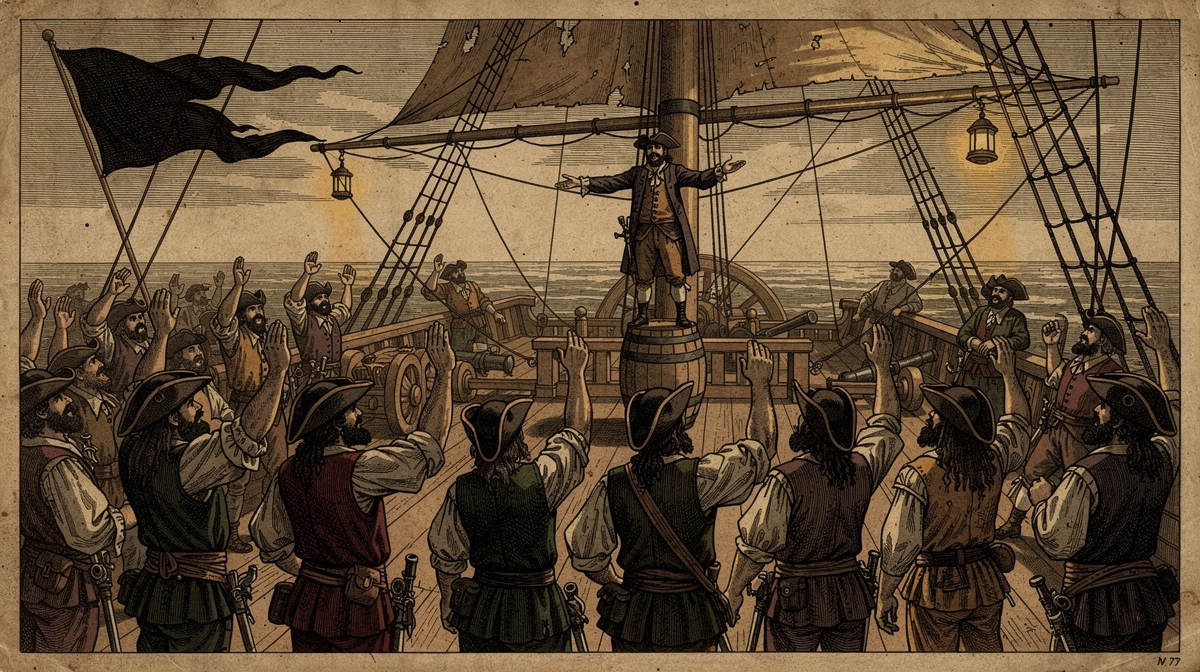
When people picture a pirate captain, they imagine a tyrant in a feathered hat, barking orders that no man dares question. The reality of the Golden Age would have surprised them. Aboard most pirate ships, the captain held absolute authority in one circumstance only: the chase and the fight. The rest of the time he served at the pleasure of his crew, and that pleasure could be withdrawn.
Every Man Has a Vote
The men elected their captain by majority vote, and by majority vote they could remove him. A commander who showed cowardice in battle, who hoarded plunder, or who abused the hands under him did not last long. The first article of one famous code put it plainly: every man had a vote in affairs of the moment. Where a sailor in His Majesty's Navy could be flogged for a sidelong glance, a pirate could stand on the deck and argue the captain down.
To keep that captain honest, the crew elected a second officer, the quartermaster, who held the purse and spoke for the men. The captain led the attack. The quartermaster divided the spoils, settled disputes, and stood as a counterweight to any commander who grew too fond of his own authority. It was a rough system of checks and balances, drawn up by men the law had already condemned to hang.
A Constitution Signed in Salt
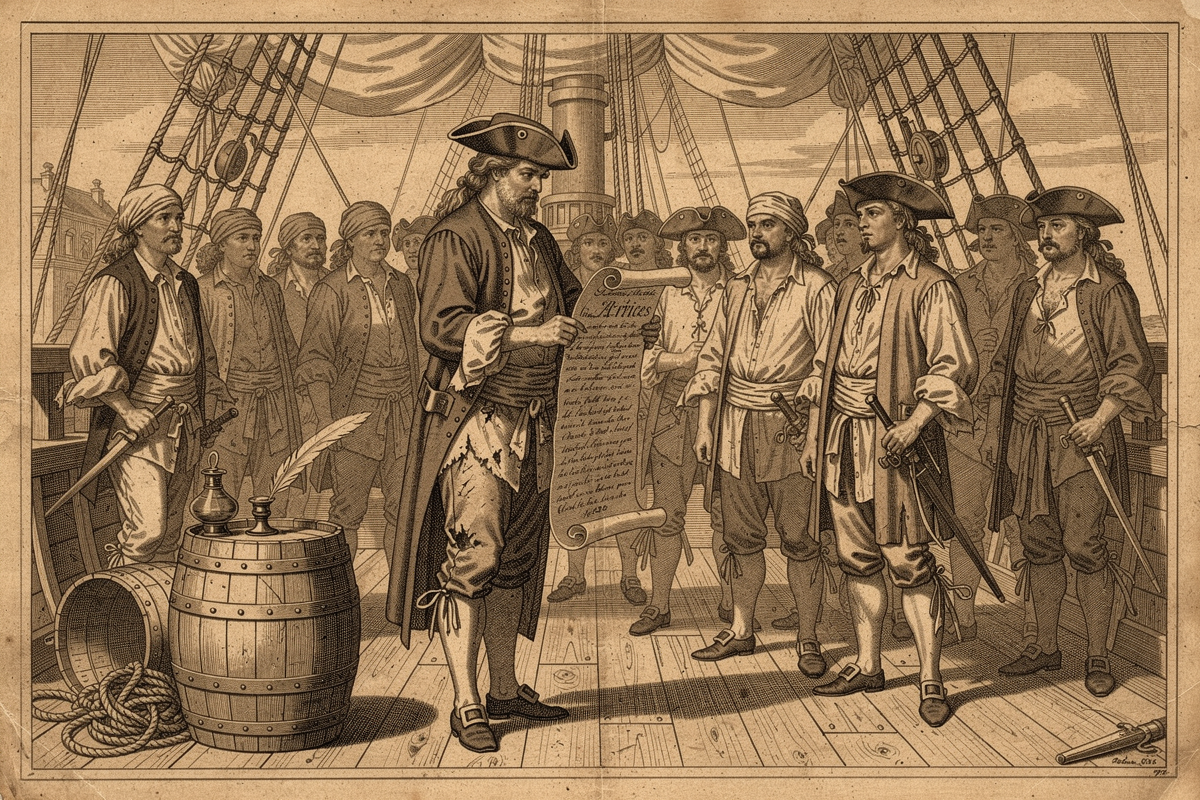
Before a voyage began, every member of the company signed, or made his mark upon, the ship's articles. These were not vague understandings. They were written constitutions, particular to each crew, laying out how plunder would be divided, what conduct would be punished, and how the company would govern itself at sea.
The division of spoils followed the articles to the coin. A captain might take a share and a half. The quartermaster, master, and gunner took a share and a quarter. Every ordinary hand took a single share, and even the carpenter and the surgeon were owed their portion for the skills that kept the company afloat and alive. Set against the merchant service, where owners swallowed the profit while the crew scraped by on fixed wages, this was a radical arrangement. A pirate held a stake in the venture. What the ship took, he took.
The articles governed conduct as well. Gaming for money was often forbidden below decks. Candles were doused at a set hour. Quarrels were carried ashore and settled with pistol and cutlass rather than left to fester among men packed into a wooden hull. Desertion or theft from a shipmate drew the harshest penalties the company could devise. A pirate crew was a floating community, and it knew that no community at sea survives without rules every man has agreed to keep.
Insurance Against the Worst
Perhaps the most surprising clause in any set of articles dealt with injury. Piracy was savage work. Cannon splinters, blade, and shot maimed the men who survived the battles they fought. So the articles set aside a portion of the common stock to compensate the wounded, a kind of insurance centuries before the word grew common.
The amounts were written down like any contract. Under one well-known code, a man who lost a limb in action was owed eight hundred pieces of eight from the shared fund, with a smaller, proportionate sum for the loss of a joint or a finger. Earlier buccaneer agreements set their own figures: six hundred pieces of eight for a right arm, five hundred for a left, and lesser amounts besides. A sailor crippled in the service of the company was not cast aside. The articles he had signed protected him.
It is worth resisting the romance here. These were violent men who lived outside the law, and their world ran on plunder taken by force. Yet within that world they built something their respectable contemporaries never offered the common man: a vote, a fair share, and a measure of security against ruin. That contradiction sits at the heart of the world I write about.
Why Men Chose the Black Flag
To understand why such a system took hold, look at the life these men had fled. A hand in the merchant service or the Royal Navy could expect meager wages, food that turned his stomach, and a captain whose word was law backed by the lash. Many had been pressed into service against their will. Discipline aboard a lawful ship was a one-sided bargain, and the common sailor signed nothing and decided nothing.
Against that, the pirate offered a man a vote, a share, and a say in his own fate. The harbors that sheltered these crews, Nassau chief among them in the years around the turn of the century, became something close to a republic of the dispossessed. Sailors who had been treated as cargo their whole lives suddenly held a stake in the venture and a voice in the company. It is small wonder that men weighed the noose against the navy and chose the black flag. The risk was death. The reward was a brief, dangerous taste of being treated as an equal.
This is the texture I reach for in Crimson Cross: Azure Waves. Not the cartoon of the swaggering villain, but the strange, ordered, surprisingly fair society that a young man raised to privilege would never expect to find among outlaws. Samuel Drayton goes to sea to hunt pirates. What unsettles him is how much sense their world begins to make.
Crimson Cross: Azure Waves is available to preorder now, in hardcover ($49.99) and paperback ($19.99), with release expected in mid-2026. You can read Chapter One free on the site, and follow the journey on YouTube (@Chris.Stirling), TikTok (@chris_stirling), and Instagram (@chrisstirling.writer). Fair winds.
Keep reading the saga
Get the first chapter of Crimson Cross: Azure Waves free, or preorder the book.
Send me Chapter One