The Pirate Round: The Secret Sea Route That Made Pirates Millionaires
The smell hits you first — salt, rot, and tar baked into timber that hasn't seen a dry dock in six months. You're two thousand miles south of the last port you trusted, the Cape of Good Africa grinding past your starboard rail, and the men around you aren't desperate fools chasing sloops in the shallows. They're investors. They're patient. And they know exactly where they're going.
Most of what gets written about Golden Age pirates is Caribbean by default. Warm water, short hops, easy escapes into shallow-draft channels the Navy couldn't follow. That picture isn't wrong. It's just small. The men who walked away genuinely rich — rich enough to buy a pardon, retire a mansion, or simply disappear — didn't work the Caribbean. They worked the Pirate Round, and the world they moved through was bigger, harder, and far more lucrative than anything Nassau ever produced.
What the Pirate Round Actually Was
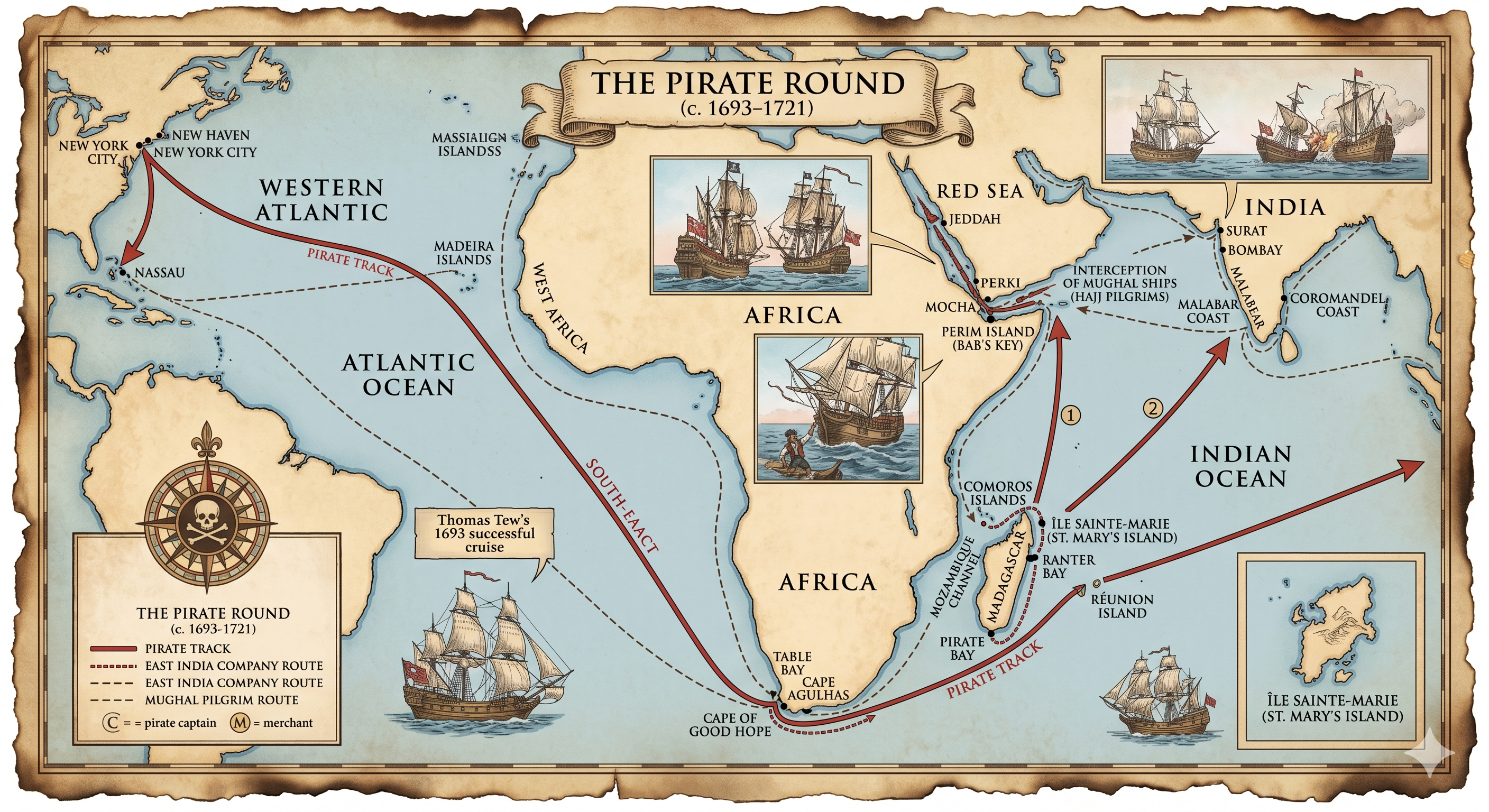
The Pirate Round was a deliberate trade route, not a loose pattern of opportunistic raiding. It ran from colonial American ports — primarily Newport, Rhode Island, and New York — south down the Atlantic, around the Cape of Good Hope, up through Madagascar, and into the Red Sea and Indian Ocean. The full circuit took the better part of two years. You didn't stumble onto the Pirate Round. You planned for it, funded it, and provisioned a ship capable of surviving it.
The target made the distance worth it. Mughal India's merchant fleet moved staggering volumes of gold, silver, silks, and spices. The annual Hajj fleets — pilgrim ships sailing from Surat to the Red Sea — carried not just passengers but the wealth those passengers brought to sustain themselves on the journey to Mecca and back. The East India Companies, English and Dutch both, moved cargo that dwarfed anything a Caribbean merchant could offer.
This wasn't a fringe operation. Between roughly 1690 and 1710, the Pirate Round functioned as a semi-organized commercial venture. Investors in colonial ports put up capital. Ships were properly outfitted. And critically, colonial governors took their cut in exchange for safe harbor and paperwork that wouldn't embarrass anyone. Governor Benjamin Fletcher of New York didn't just look the other way — he had Thomas Tew to dinner and posed for it. Rhode Island's ports were quiet about what they knew. The Pirate Round ran, for a while, because powerful men on both sides of the Atlantic wanted it to run.
The Men Who Made It Famous — and What It Cost Them
Henry Every is the name that survives. In 1695, Every and his crew took the Ganj-i-Sawai, a Mughal imperial vessel, in the Red Sea. The haul was somewhere between £325,000 and £600,000 in period money — by most estimates the largest single pirate prize ever taken. Every had the rare fortune of disappearing cleanly afterward. He was never caught. He became the template: proof that the Pirate Round could pay off, that a man could come home from it whole.
Thomas Tew ran the route twice and got neither outcome cleanly. His first voyage, 1693, brought him back to Newport wealthy enough to make him a celebrity. He was received in New York like a man who'd done something admirable. His second voyage, 1695, ended in the same Red Sea engagement that made Every famous. Tew took a cannonball or a blade to the gut — accounts differ — and died in the fight. Two voyages: one legend, one corpse.
William Kidd is the cautionary tale the Crown needed badly enough to manufacture. He sailed with legitimate papers, legitimate backers — English lords among them — as a privateer, not a pirate. He ended up on the Pirate Round anyway, took the Quedagh Merchant in 1698, and found that his political protection evaporated the moment it became inconvenient. He was arrested, tried in a proceeding that was closer to theater than law, and hanged at Execution Dock in 1701. His tarred body hung in a gibbet over the Thames for three years, placed there specifically to be seen by sailors coming into London. The message was deliberate. The Pirate Round had become politically costly, and Kidd paid for the men who never did.
Why the Pirate Round Collapsed — and Why It Matters
The end of the Pirate Round wasn't just naval enforcement. It was diplomacy. When Henry Every's crew attacked the Ganj-i-Sawai, they didn't just rob a ship. They attacked subjects of the Mughal Emperor Aurangzeb, one of the most powerful rulers on earth. Aurangzeb's response was swift and damaging: he imprisoned East India Company factors across India and threatened to expel English trade entirely. The English Crown suddenly had a real crisis that pirates had caused. The Pirate Round made piracy a foreign policy problem, not just a domestic nuisance.
Madagascar — specifically the island of Île Sainte-Marie, a few miles off the northeast coast — served as the principal waystation for the entire operation. At its peak it held a functioning pirate settlement where crews could winter between raids, repair ships, trade with local communities, and wait for the right season to push north into the Red Sea. Some men arrived there and never left. They married local women, fathered children, and built something that wasn't quite a colony and wasn't quite a town. Misson's legendary settlement of Libertalia — the pirate utopia that appears in Captain Charles Johnson's 1724 General History of the Pirates — was likely drawn from Sainte-Marie's reality, however mythologized the telling became.
What the Pirate Round built, in its short window, was a shadow economy connecting colonial America to the Indian Ocean. The same ports that provisioned pirate ships also sold the goods they brought home. The same investors who funded legitimate merchant ventures put money into Round voyages when the odds looked right. The line between privateer, merchant, and pirate on this route was less a legal distinction than a matter of paperwork and timing. When the Crown finally moved against it — prosecuting Kidd, issuing the 1699 Act for the More Effectual Suppression of Piracy, pressing colonial governors to stop playing both sides — they weren't just hunting criminals. They were dismantling a trade network that had operated in plain sight.
The men who got rich from the Pirate Round understood something the Caribbean raiders mostly didn't: distance is a weapon. Twenty thousand miles of open ocean between you and the authorities who want you dead is worth more than any fast sloop or hidden cove. Most of them lost anyway. Kidd hanged. Tew bled out. Every vanished into a silence so complete historians still argue about where he ended. But for one sharp decade, the Pirate Round was the most profitable criminal enterprise on the face of the planet.
Keep reading the saga
Get the first chapter of Crimson Cross: Azure Waves free, or preorder the book.
Send me Chapter One